Thread et synchronisation en Java
Jérôme David - Florian Rodriguez
1. Introduction
- Thread : « processus léger »
- Un processus peut contenir plusieurs Thread
- Tous les threads d’un processus partagent son espace mémoire
- Chaque thread a son propre pointeur d’exécution (Program Counter)
- Permet de paralléliser des traitements
- Par défaut, il y a au moins un thread pour l’exécution de l’application, un ou plusieurs pour le ramasse-miettes
- Inconvénients : utilise des ressources
2. Contenu d'un Thread
- Du code, un algo à exécuter
- Dans la méthode
public void run() - Méthode à redéfinir
- Dans la méthode
- Une méthode pour le démarrer
public void start()
- Un thread vit jusqu'a la fin de sa méthode
run()- Endormir un thread :
void sleep(int milisec) - Mettre en attente un thread :
void wait()
- Endormir un thread :
3. Création des threads
- Pour créer un bon vieux thread, il existe deux façons :
- Dériver la classe
Thread(et redéfinir la méthoderun()) - Implémenter l'interface
Runnable(et définir la méthoderun())
- Dériver la classe
4. Dérivation de la classe Thread ou implémentation de Runnable
Dérivation de la classe Thread
class MonThread extends Thread {

    public MonThread() {
        // initialisation
    }

    public void run() {
        // le code de l'action du thread
    }
}
MonThread t = new MonThread();
t.start(); // execute la methode run() de MonThread en
           // parallele au thread de ce programme
Implémentation de l'interface Runnable
class MaTache implements Runnable {

        public MaTache() {
                // initialisation
        }

        public void run() {
                // le code de l'action du thread
        }
}
MaTache tache = new MaTache();
Thread t = new Thread(tache) ;
t.start(); // execute la methode run() de MaTache en
           // parallele au thread de ce programme
5. La classe Thread - méthodes statiques -
- Méthodes qui agissent sur le thread qui exécute la méthode
Thread.sleep(long milisec): endort le thread courantThread.currentThread(): retourne une référence vers le thread courantThread.yield(): le thread passe son tour
6. La classe Thread - méthodes d'instances -
Thread t = new Thread();
t.start(): démarre le thread- Méthode non bloquante (redonne tout de suite la main)
- Exécute le contenu de run() en parallèle
t.join(): bloque le thread appelant tant que t n'est pas terminét.yield(): le thread t passe son tour pour être exécuté- Etc…
7. La synchronisation
- Se fait par le moniteur d'un objet
- Moniteur = verrou + liste d'attente
- Tout objet possède un moniteur
- Etant donné un
Object oo.wait(): bloque thread qui l'exécute- Le thread est mis dans la file d'attente du moniteur de o
o.notify(): réveille un des threads qui attendo.notifyAll(): réveille tous les threads qui attendent- Ces méthodes peuvent lever des
InterruptedException
8. Cycle de vie d'un Thread
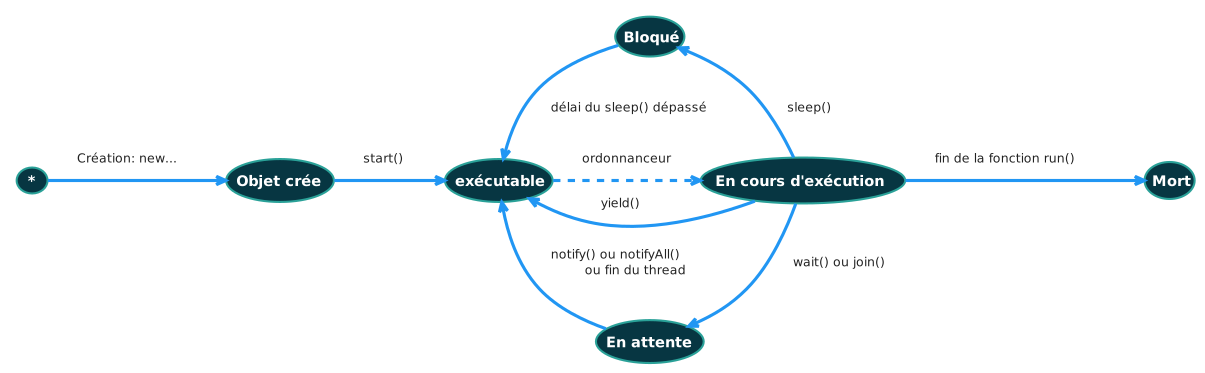
9. Interruption d'une tâche
Un thread bloqué peut être interrompu via la méthode
void interrupt()class MonThread extends Thread { public void run() { try { Thread.sleep(100); System.out.println("Je me suis réveillé tout seul"); } catch (InterruptedException e) { System.out.println("On m'a réveillé :-("); } } }MonThread t = new MonThread(); t.start(); Thread.sleep((long) (Math.random()*200)); t.interrupt();
10. L'exclusion mutuelle
Mot-clé
synchronizedpublic class ExclusionMutuelle { public static void main(String[] args) throws InterruptedException { Compte c = new Compte(); Thread[] lesThreads = new Thread[10]; for (int i=0 ; i<lesThreads.length ; i++) { lesThreads[i] = new Thread() { public void run() { for (int i=0 ; i<1000 ;i++) { c.deposerUnEuros(); } } }; lesThreads[i].start(); } for (Thread x : lesThreads) { x.join(); } System.out.println(c.value); } }class Compte { public volatile int value; // methode appelée en exclusion mutuelle // grâce au mot clé synchronized public synchronized void deposerUnEuros() { value+=1; } }
11. Synchronized
- Utilisations du mot clé synchronized
Devant une méthode (verrouille l'objet sur lequel est appelée la méthode) :
class Compte {
    public volatile int value;
    public synchronized void deposerUnEuros() { value+=1; }
}
En tant que bloc :
class Compte {
    public volatile int value;
    public Object lock = new Object();
    public void deposerUnEuros() {
        synchronized(lock) { value+=1;}
    }
}
12. Interbloquage
- Attention à l'interbloquage si on imbrique des blocs synchronisés
class MonThread1 extends Thread {
  public void run(){
     synchronized(a){
        . . .
        synchonized(b){
             . . .
        }
     }
  }
}
class MonThread2 extends Thread {
  public void run(){
     synchronized(b){
        . . .
        synchonized(a){
             . . .
        }
     }
  }
}
13. Attente passive
- La méthode
wait()appelée sur un objeto, met le thread appelant en attenteo.wait(),o.wait(long millisec), …- Doit être appelée en exclusion mutuelle avec
synchronized (o) { o..wait() ; }par exemple - Peut lever une
InterruptedException
- Pour « réveiller » le thread en attente, un autre thread doit appeler
o.notify(): réveille un des threads en attente (on ne controle pas lequel)o.notifyAll(): réveille tous les threads en attente
14. Exemple
- Démo
15. Les sémaphores
- Exercice : implémenter une classe sémaphore avec les moniteurs
- Il existe une classe toute prête pour cela :
java.util.concurrent.Semaphore Semaphore sem = new Semphore(int nbJetons);sem.acquire();- pour prendre un jeton, avec attente si non disponible
boolean res = sem.tryAcquire();- prendre un jeton si disponible sans attendre
- On peut passer aussi un délai d'attente en paramètre
sem.release();- pour relâcher le jetons
16. Limites du synchronized
- Porte sur une méthode maximum
- On ne peut pas verrouiller dans une méthode et déverrouiller dans une autre
- Le relâchement de verrous se fait dans l'ordre opposé
- premier verrou obtenu, dernier relâché
- Une seule file d'attente sur un moniteur
- Pas de gestion de l'équité
- Le thread qui attend depuis le plus longtemps n'est pas nécessairement servi en premier
17. ReentrantLock
- Verrou avec extensions par rapport au moniteurs + synchronized
class X {
        private final ReentrantLock lock = new ReentrantLock();

        public void m() {
                lock.lock(); // prise de verrou bloquante
                try {
                        // ... code en exclusion mutuelle
                } finally {
                        lock.unlock(); // relâche le verrou
                }
        }
}
class Y {
        private final Object lock = new Object();
        // ...

        public void m() {
                synchronized(lock)  { // prise de verrou bloquante
                        // ... code en exclusion mutuelle
                } // relache le verrou
        }
}
18. Synchronisation avec ReentrantLock
- On peut obtenir plusieurs conditions (files d'attente) sur un verrou
class Z {
        private final ReentrantLock lock = new ReentrantLock();
        private final Condition  cond = lock.newCondition();

        public void arriveeRDV() throws InterruptedException {
                lock.lock();
                try {
                        cond.await(); //attendre
                } finally {
                        lock.unlock();
                }
        }

        public void debloquerRDV() throws InterruptedException {
                lock.lock();
                try {
                        // reveiller
                        cond.signal(); //cond.signalAll();
                } finally {
                        lock.unlock();
                }
        }
}
19. Autres classes pour synchronisation
- Les barrières : bloque des threads en un point jusqu'à ce qu'a ce que
le nombre requis de threads aient atteint ce point
CyclicBarrier,CountDownLatch